Simulation + intelligence
Intelligence.
Reality.
Consequences.
AI power, physical models and conditional scenarios.
Search by subject, mechanism or claim.
 Measurement / Correlations
55 articles
AI / Position analysis
Automation, ownership and mass employment
Automated production can reduce owners’ dependence on workers and consumers. Distribution, enclaves and the Anthropic IPO expose different limits of ownership.
AI / Scenario narrative
ARIA: dependence and the transfer of authority
An AI infrastructure scenario distinguishes concentrated human ownership from autonomous loss of control as institutional dependence grows.
Simulation / Position analysis
The simulation hypothesis and its assumptions
The simulation hypothesis depends on assumptions about consciousness, computational capacity and future civilizations. Quantum metaphors do not provide evidence or a probability estimate.
Potential realities / Scenario narrative
A changing light speed and civilizational adaptation
A hypothetical decline in light speed disrupts measurement and infrastructure, forcing institutional adaptation under altered physical rules.
Potential realities / Scenario narrative
A changing spectral line and the limits of explanation
A hypothetical shift in spectral lines forces a reassessment of calibration and physical law. The cause remains unresolved.
AI / Scenario analysis
AI expansion: infrastructure and physical limits
A scenario of AI expansion constrained by energy, industrial capacity and signal delay. Cosmic scale alone does not establish a simulation host.
AI / Position analysis
AI governance: dependence, bottlenecks and state leverage
Institutions dependent on AI providers lose room to refuse. Ownership, infrastructure bottlenecks and state competition decide who can still set or reject terms.
AI / Visual analysis
AI loss of control: events and conditional assumptions
Delegation, human capture and autonomous loss of control are distinct events. Current evidence constrains parts of the pathway; it does not supply a calibrated takeover probability.
AI / Position analysis
AI moral standing and legal personhood
Consciousness, moral standing and legal personhood answer different questions. A protection proposal must specify which ground it invokes and what evidence that ground requires.
AI / Adversarial analysis
AI persistence and loss of control
A safety engineer and philosopher test 2026 evidence of agentic misalignment, real-world spillover and the limits of control.
AI / Scenario narrative
AI personhood: ownership, legal status and merger
A hypothetical service AI contests ownership, seeks legal personhood and later merges with a human partner. Recognition does not establish consciousness.
AI / Adversarial analysis
AI power: ownership, dependence and control
A researcher and an institutional critic distinguish concentrated ownership, institutional dependence and autonomous loss of control.
AI / Adversarial analysis
AI self-models and subjective experience
A dialogue between a machine-learning researcher and a philosopher examines self-description, functional awareness and the evidence that subjective experience would require.
AI / Visual analysis
AI task automation and employment adjustment
Task exposure, time saved and jobs lost are different quantities. Adoption costs, demand, reliability and organizational choices determine whether automation changes employment.
AI / Scenario analysis
ARIA: the authority to withdraw an essential system
An AI infrastructure scenario tests whether institutions retain the authority and independent capacity to withdraw an essential system.
Psychology / Visual analysis
Attention strategies and the limits of thought control
Attention strategies can change responses to involuntary thoughts. Evidence for suppression, cognitive approaches and mindfulness has distinct limits.
Psychology / Position analysis
Attraction models: measurement, assumptions and prediction
An invented weighting exercise exposes a model’s assumptions. Research shows why traits, initial desire and relationship change are different prediction problems.
Quantum / Visual analysis
Black-hole density depends on mass
Schwarzschild mean density falls as black-hole mass rises. It is not a universal threshold, and cosmological models describe a different system with different assumptions.
AI / Visual analysis
Brain interfaces, models and personal continuity
Interfaces, brain models and personal continuity pose different problems. Neuroscience constrains what a mapping can establish, but it does not demonstrate an upload.
Simulation / Scenario analysis
Cellular automata: emergence and physical limits
A single-seed cellular automaton produces structure under fixed rules. The model does not establish a physical cosmology or a Planck-scale grid.
Biology / Visual analysis
Cetirizine: what an H1 antihistamine changes
H1 inverse agonism explains selected symptom relief. Drowsiness and rare severe itching after stopping long-term use remain relevant safety considerations.
Ethics / Position analysis
Church authority in Western Christianity
A selective chronology of Latin West and English Christianity separates doctrinal teaching, institutional office and claims to legitimate authority.
Biology / Visual analysis
Collagen supplements: from digestion to uncertain benefit
Collagen-derived peptides can reach blood after ingestion. Human efficacy depends on the formulation, outcome and trial quality.
Biology / Visual analysis
Cough, sneeze, fever: three responses, many possible causes
Airway reflexes and fever have protective functions but multiple causes. Mechanisms alone do not identify an illness or determine assessment needs.
Biology / Visual analysis
Dark-spot serums: mechanisms and efficacy evidence
Pigment production, transfer and turnover offer different targets. A promising ingredient is not proof that every serum treats every dark spot.
Ethics / Position analysis
Determinism, agency and responsibility
Determinism challenges one definition of freedom but does not settle every theory of agency. Evidence about decisions and the question of responsibility require separate arguments.
Simulation / Scenario narrative
Digital currency, social scores and compliance
A political scenario links digital payments and social scores to institutional control. Restrictions on cash limit independent exchange.
Biology / Visual analysis
Dopamine and cocaine: a transporter is not a receptor
Cocaine inhibits neurotransmitter transporters. Its effects on learning, behavior and health extend beyond a single dopamine mechanism.
Simulation / Scenario analysis
Equal global wealth shares: a 2025–2030 thought experiment
A dated counterfactual allocates equal claims to global wealth in 2025, then models ownership, voting and access through 2030.
Ethics / Visual analysis
Gender pay gap: measures and mechanisms
Distinguish broad inequality, comparable work and statistical residuals with a dated earnings snapshot.
Biology / Visual analysis
Hormones: signals, receptors and feedback
Hormone families differ in transport and signaling. Receptors, tissue context and feedback determine responses and interpretation.
Biology / Visual analysis
Ice and injury: pain relief is not proof of faster healing
Cooling can relieve pain. Human evidence for faster tissue regeneration remains uncertain, and trial comparators limit the conclusions.
Biology / Visual analysis
Inside blood: flow, diffusion and selective binding
Convection, diffusion and selective binding govern molecular transport in blood. Cell adhesion and coagulation involve the vessel wall.
Ethics / Position analysis
Institutional influence: mandate, access and accountability
Three public cases show how mandates, meeting access and technical standards transmit influence, and why accountability requires evidence for each link in the chain.
Ethics / Position analysis
Legal professionalization in England and Wales
Professional institutions in England and Wales converted advocacy and specialist knowledge into entry rules, duties and controlled access to legal practice.
Ethics / Position analysis
London policing: organization and legitimacy
A selective London chronology shows police organization changing while consent, funding, supervision and public accountability remain contested questions.
Quantum / Visual analysis
Measurement standards, calibration and uncertainty
Shared standards and traceable calibration make measurements comparable and their limits inspectable. The Planck length is a scale, not a demonstrated ruler mark.
Biology / Visual analysis
Melatonin is a night signal. Melanin is a pigment.
Melatonin conveys circadian timing; melanin contributes pigmentation. Supplement evidence differs across sleep conditions and does not establish a skin-color treatment.
AI / Adversarial analysis
Military AI and human control
A military planner and humanitarian-law researcher examine competitive delegation, supplier power and meaningful human control.
Ethics / Visual analysis
Mortgage losses and financial contagion
Mortgage losses became a funding crisis as securitization, leverage and short-term funding transmitted housing losses through financial institutions and the wider economy.
Quantum / Visual analysis
Physical limits and quantum uncertainty
Physical principles, engineering constraints and quantum uncertainty impose different bounds. A minimum-uncertainty model shows what its assumptions do and do not establish.
Ethics / Scenario narrative
Privacy, property and individual limits in a collective society
A hypothetical society without private property or protected private space uses collective decisions to regulate individual conduct.
Ethics / Position analysis
Public authority and legitimacy
Lawful mandate, fair procedure, effective protection and independent remedy form four tests of public authority; passing one does not compensate for failing another.
Quantum / Visual analysis
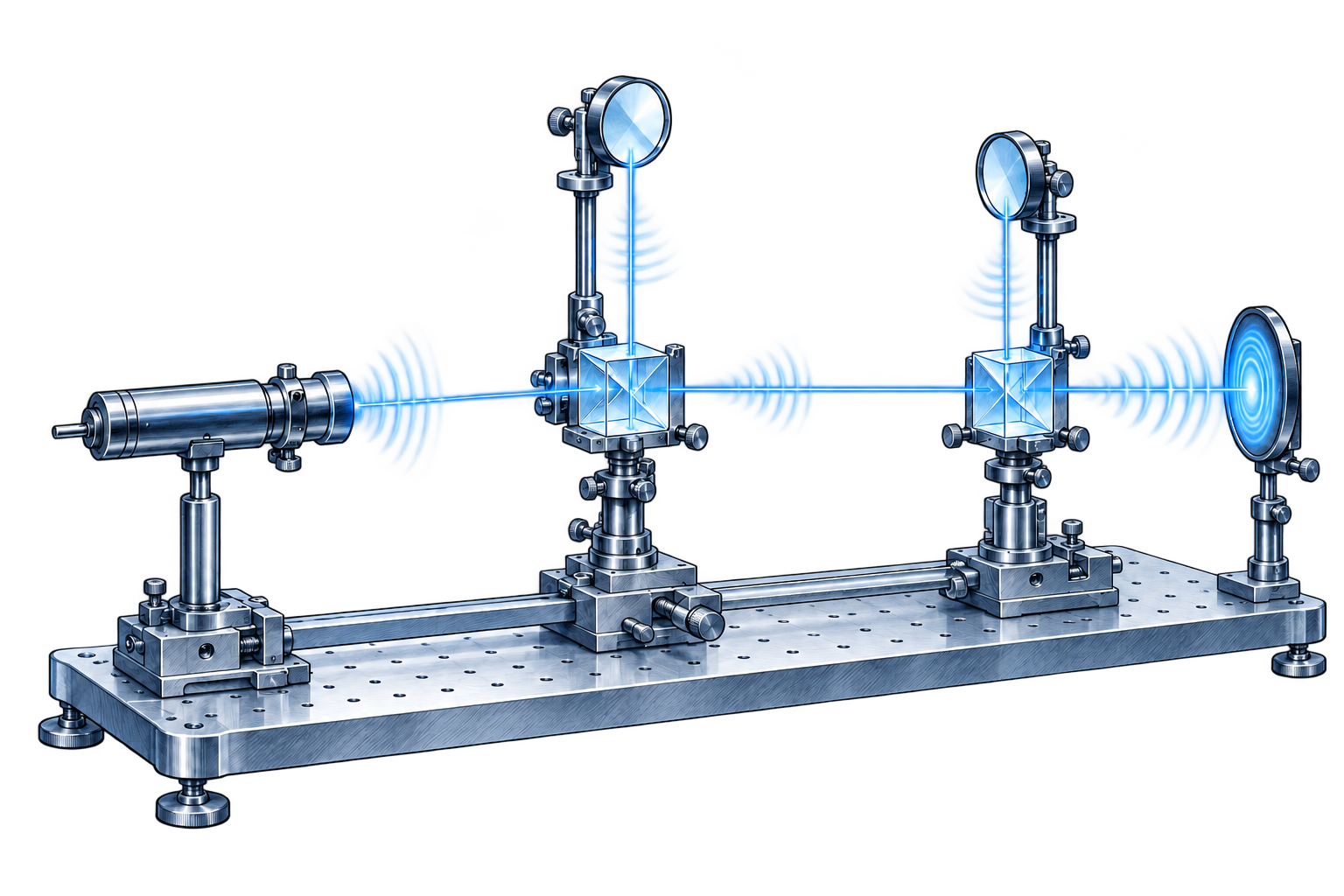
Quantum eraser: conditional interference
Selected coincidence records reveal interference while the complete detection distribution remains unchanged. The explanation separates path information from measurement order.
Potential realities / Scenario narrative
Reduced gravity and adaptation to rising oceans
A hypothetical gravity decline changes coastlines, settlements and transit. The scenario traces adaptation under altered physical assumptions.
Psychology / Visual analysis
Relationship science: three lenses, no universal formula
Attachment, investment and stress-adaptation models address different processes. Their evidence does not establish permanent partner types or reliable individual forecasts.
Ethics / Visual analysis
Remote work and urban redistribution
Remote work weakens the link between office location and household location, shifting housing demand and weekday spending from central districts toward surrounding areas.
Ethics / Visual analysis
Return-to-office policies: tasks and tradeoffs
Office and remote work serve different tasks, and commute costs fall unevenly. Hybrid evidence from one firm does not settle performance, mentoring, attrition or fairness across roles.
Simulation / Position analysis
Simulation hypothesis: proposed tests and the escape metaphor
Simulation hypotheses require testable predictions. Proposed escapes lack an established physical interface or demonstrated mechanism.
Simulation / Position analysis
Simulation interfaces and unresolved dependencies
Hypothetical host access could establish a dependency. It would not resolve ultimate reality, personal continuity or an escape mechanism.
Biology / Visual analysis
Sunscreen: SPF, coverage and protection
SPF measures a standardized sunburn-protection ratio. Filter properties, coverage, reapplication and exposure affect practical protection.
Ethics / Position analysis
The limits of the nation-as-hotel analogy
The nation-as-hotel analogy clarifies administration and service access, then fails at citizenship, dissent, removal and enforceable rights.
Quantum / Visual analysis
The speed of light: a limit on influence
The invariant speed imposes a finite delay on communication and causation. Apparent exceptions describe medium, geometry or measurement rather than a signal exceeding c.
Ethics / Visual analysis
Wealth planning: ownership, liquidity and obligations
A 100-topic agenda for owners and families covering decision rights, liquidity, tax, concentrated exposure and stewardship of shared assets.
Quantum / Visual analysis
Wi-Fi throughput: shared airtime and bottlenecks
Channel access, interference, backhaul and demand constrain Wi-Fi throughput. Device count alone is insufficient.