Quantum optics / A visual field guide
Quantum eraser: conditional interference
Selected coincidence records reveal interference while the complete detection distribution remains unchanged. The explanation separates path information from measurement order.
Begin the explanation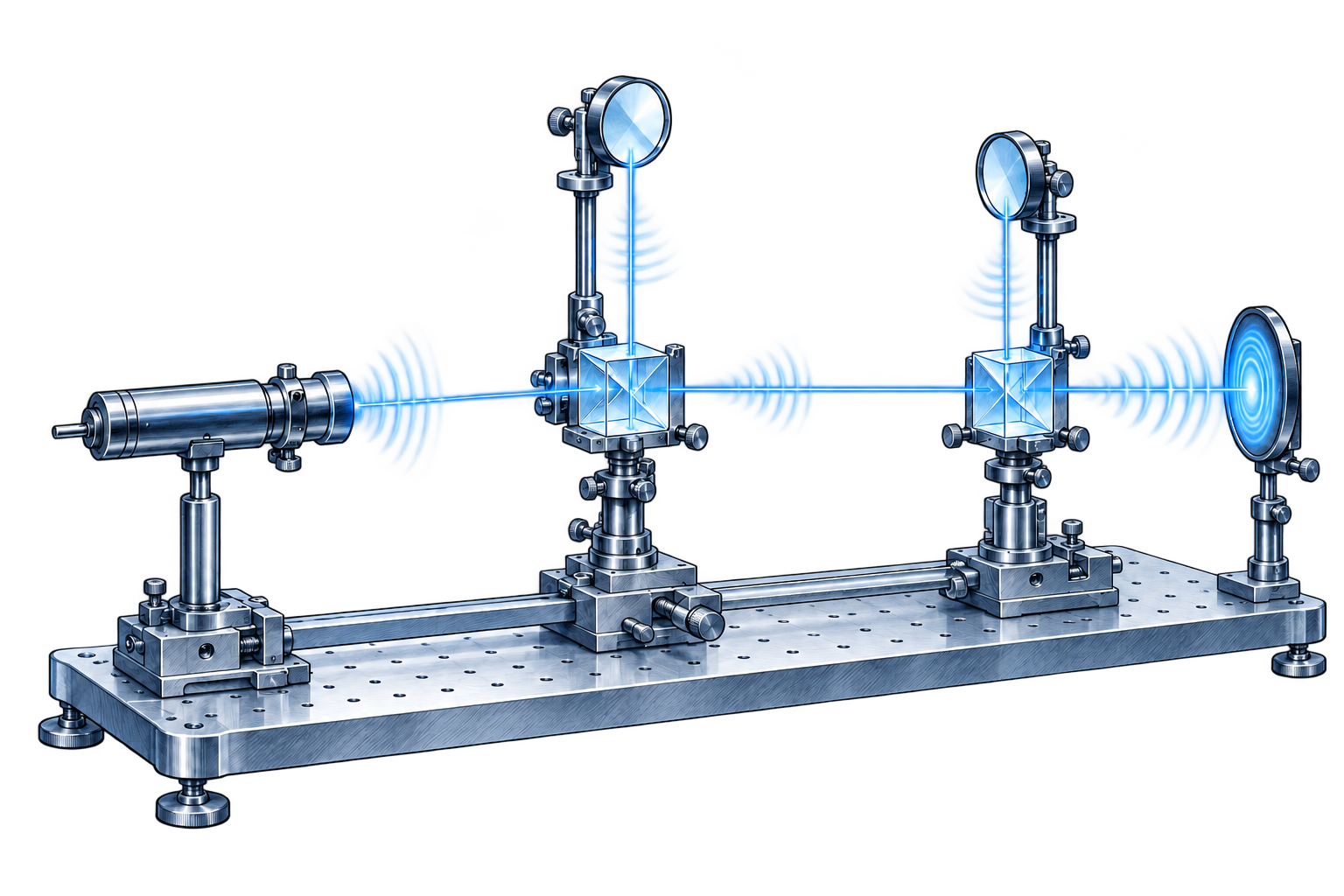
The conceptual eraser is drawn in Figure 01.
01 / The question
What, exactly,
has been erased?
A quantum eraser can reveal interference in selected correlations while the complete signal record remains fringe-free. The distinction is between the whole record and a carefully defined subset.
In a paired-photon experiment, one photon provides a detection position and its partner provides an outcome label. Positions alone give one distribution. Pairing the records gives a conditional distribution: detection positions given a particular partner outcome.[1]
Interference appears in the conditional distribution. No pattern is written over earlier detections.
The alternatives carry
correlated partner states.
Keep every detection.
The unsorted pattern has no fringes.
Choose a measurement basis.
Use its labels to sort joint results.
02 / Mark the alternatives
A path can leave a mark
without anyone looking.
Interference depends on how alternatives combine. When two paths lead to the same final state, their complex amplitudes add before the probability is calculated. If the paths leave orthogonal, distinguishable tags in another degree of freedom, the signal alone loses that interference term.[2]
The tag might be polarization, an environmental state, or an entangled partner. A conscious observer is not a necessary ingredient. What matters is the physical distinguishability of the alternatives in the joint state.
When ⟨a|b⟩ = 0, the tags are orthogonal. Ignoring the tag removes the cross term from the signal's reduced state.
03 / Read the correlations
Change the basis.
Then ask a joint question.
Measure the partner in a basis that mixes its two path tags. In an ideal balanced eraser, each of the two outcomes can condition the signal into a coherent superposition. One subset shows fringes; the other shows complementary fringes. Their modulation cancels when the equally weighted subsets are combined.[3]
“Erasing” is not deleting an inconvenient entry from a notebook. It is arranging a measurement whose selected outcome does not distinguish the original path alternatives. The full joint state and the measurement basis explain the result.
Same experiment.
A different question.
Inspect the full distribution, then select either erasing outcome. The choice of subset reveals a pattern; it does not alter an earlier click.
Without the partner's outcome label, the two complementary patterns average to the same uniform distribution.
The sum is the crucial part.
Let θ describe one fringe period and φ the prepared phase. The model uses normalized conditional densities p(θ|+) = [1 + cos(θ + φ)] / 2π and p(θ|−) = [1 − cos(θ + φ)] / 2π. Each outcome has probability ½, so their weighted sum is p(θ) = 1 / 2π.
Moving the source-phase control shifts the two conditional patterns. It leaves their average unchanged. Selecting a different subset is a different operation: it changes the conditioning outcome, not the prepared state. Neither action in this study means reaching back to move a recorded click.
A different reading
of the correlations.
The same recorded past.
04 / What “delayed” means
Later is not
the same as backwards.
The partner can take a longer optical path, so the signal may be detected before the partner outcome becomes available. A later comparison can still reveal correlations. The earlier signal record remains unchanged. It contains no partner labels with which to select a conditional distribution.[4]
This does not provide a way to send a message into the past or faster than light. Without the outcome labels, the signal observer has the same marginal distribution. Bringing the two data sets together takes an ordinary communication channel.
It also helps to separate different experiments. Wheeler's delayed-choice interferometer changes a measurement arrangement. The Kim-style eraser uses an entangled pair and passive splitter routing. Both probe quantum predictions, but they are not interchangeable diagrams or mechanisms.[4]
- 01A pair is prepared.
One joint quantum state.
- 02A signal click is recorded.
A position in the full record.
- 03The partner is detected.
A correlated outcome label.
- 04The records are compared.
Conditional patterns become visible.
From explanation to experiment
Keep the whole
record in view.
In Quantum Lab, choose lesson O or P. Compare the unconditional D0 chart with the D1 and D2 coincidence subsets. Then shift the source phase and inspect what moves.
Open Quantum Lab- 01
Compare the full record
with each selected subset. - 02
Change the source phase.
Watch the conditional fringes. - 03
In P, delay the partner.
Distinguish timing from correlation.
The lab is an idealized optics model. Lessons O/P include the Kim-style path-preserving outcomes; this page's two-outcome figure is a simpler explanatory model.
05 / Go to the source
The ideas behind
the explanation.
- 01Kim, Yu, Kulik, Shih & Scully
Delayed “Choice” Quantum Eraser · Physical Review Letters 84, 1–5 (2000).
The paired-photon experiment and conditional coincidence patterns. - 02Feynman, Leighton & Sands
The Feynman Lectures on Physics · Volume III, chapter 3.
How amplitudes combine when alternatives are distinguishable or indistinguishable. - 03Scully & Drühl
Quantum eraser · Physical Review A 25, 2208 (1982).
The proposal connecting which-path information, quantum erasure and delayed choice. - 04Ma, Kofler & Zeilinger
Delayed-choice gedanken experiments and their realizations · Reviews of Modern Physics 88, 015005 (2016).
A review of the distinct delayed-choice experiments and their interpretation.