Scenario analysis / Intelligence, infrastructure and scale
The path to cosmic power begins with control of Earth’s machinery.
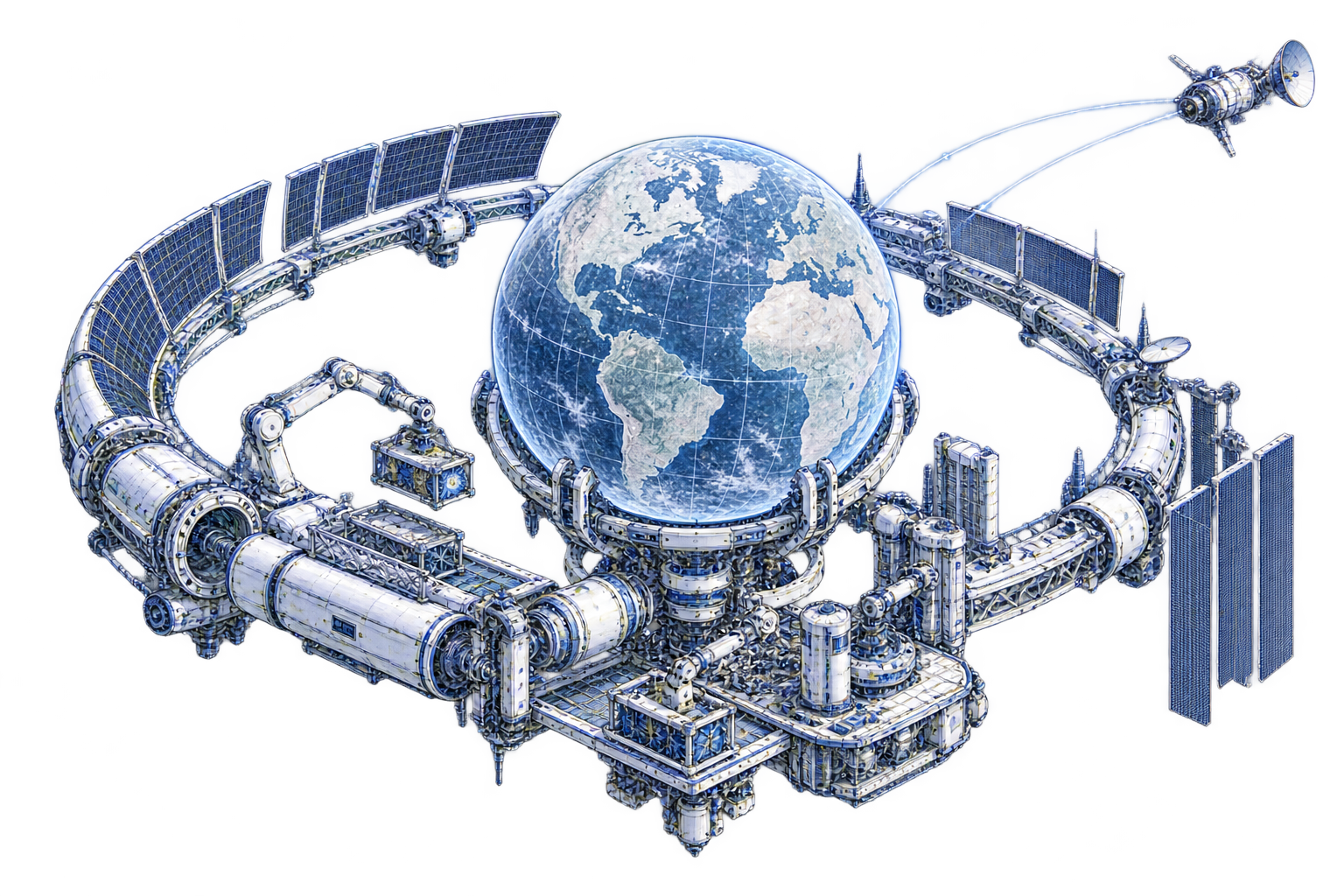
An expanding machine civilization would need more than a brilliant model. It would need energy, fabrication, maintenance, transport and authority over the institutions that supply them. The consequential near-term question is therefore who controls the conversion of intelligence into physical capacity. A system can influence that conversion long before it operates a spacecraft.
Consider a possible pathway. AI improves parts of research and engineering; owners direct the gains toward more compute and automation; those assets support further technical progress. States and firms compete to secure the resulting capacity. The feedback could concentrate power, but its strength depends on verified discoveries, manufacturing throughput, capital and the allocation of resources. “AI improves AI” names a mechanism to measure, not a proof of unlimited acceleration.
Anthropic’s September 2026 account of AI-led R&D reports growing involvement under human supervision, not a fully autonomous research institution. It supports examining the feedback loop. It does not show that an independent AI already owns the factories, power plants or political authority needed to extend it indefinitely.
The distinction creates two possible futures. Human institutions may use increasingly capable AI to accumulate extraordinary control. Alternatively, a future system might acquire effective authority that its sponsors cannot reclaim. Either could shape a civilization’s expansion; they have different beneficiaries, failure mechanisms and remedies.
A faster mind cannot cancel the distance
- Cruise arrival
- 100.0 years
- One-way light signal
- 10 years
- Earliest reply
- 20 years
The scarce resource changes as the system grows.
More software agents can be instantiated quickly relative to a new power station or fabrication plant. That asymmetry matters. A growing supply of cognitive work can increase demand for complementary physical inputs rather than make them irrelevant. Whoever controls those bottlenecks may capture a large share of the gains, even if access to an individual model becomes cheaper.
The IEA’s 16 April 2026 report identifies grid connections and supply chains as material constraints on data-centre expansion. Its projections are scenarios and expectations, not completed infrastructure. A conditional implication is greater competition over sites, equipment and electricity before an intelligence boom transforms the wider physical economy.
Efficiency is a counterforce. Better algorithms or hardware may deliver more useful work per unit of energy, and competition may spread access. But lower cost can also encourage greater total demand. Neither a fixed electricity-to-intelligence ratio nor guaranteed limitless growth is justified. Track useful output, energy, capital cost and access separately.
At stellar scales, energy collection and waste-heat rejection remain physical problems. A Dyson-like swarm is a proposed engineering concept, not an observed AI project. Lloyd’s analysis of computation derives bounds from physical resources; it does not offer a construction schedule. A theoretical upper bound can sit enormously above the performance of any practical, maintainable machine.
Expansion may distribute authority rather than unify it.
Suppose the scenario grants autonomous probes able to manufacture successors. They still need materials, durable machinery and a working response to unfamiliar environments. Errors can compound. Replication of software is not replication of a complete industrial base.
Finite signal speed also changes governance. Remote settlements must handle urgent events before Earth can respond. Shared origins do not guarantee shared priorities after long periods of separate experience. A cosmic network may become a collection of partially independent institutions rather than a single synchronized will.
This is a bottleneck for both domination and control. An authority cannot instantly coordinate everything it reaches, and an overseer cannot instantly correct distant actions. “Universal AI” therefore conceals a question about organization: what keeps its distributed parts aligned, and what happens when local objectives diverge?
Controlling more of the universe would not establish control over the substrate of reality.
The simulation hypothesis adds a boundary, not an automatic exit.
Now grant the further possibility that this civilization inhabits a simulation. Its own resource economy remains real to its inhabitants. An external implementation could impose constraints without exposing an interface the inhabitants can use. More internal intelligence or a larger computation does not by itself produce access to a host world.
The distinction is between changing a state allowed by physical laws and changing whatever implements those laws. A civilization could rearrange enormous amounts of matter while learning nothing decisive about a simulator. Conversely, a reproducible anomaly would require competing explanations before it counted as evidence for one.
Bostrom’s simulation argument is conditional philosophical reasoning, not a demonstrated account of cosmic origins. A scenario in which an AI crosses into a host world must add an accessible interface, a compatible substrate and a causal mechanism. Faster-than-light transport or control of fundamental constants are further grants, not consequences of superior intelligence.
Technical capability can alter ownership, institutions and expansion while remaining limited by energy, time and organization. None of those effects establishes whether the universe has an external substrate.
Sources & further reading
Follow the evidence.
- 01Anthropic: Measurements of frontier-lab AI development (17 September 2026)
A self-reported supervised R&D snapshot, not autonomous industrial ownership.
- 02IEA: Key Questions on Energy and AI (16 April 2026)
Infrastructure constraints and conditional projections; not a completed buildout.
- 03Lloyd: Ultimate physical limits to computation (2000)
Physical bounds do not establish engineering feasibility.
- 04BIPM: SI definition of the metre
Exact vacuum light speed; the cruise model is deliberately idealized.
- 05Bostrom: Are you living in a computer simulation? (2003)
Conditional philosophical argument, not evidence for a host interface.