01 / The proposal
Initial state and update rules
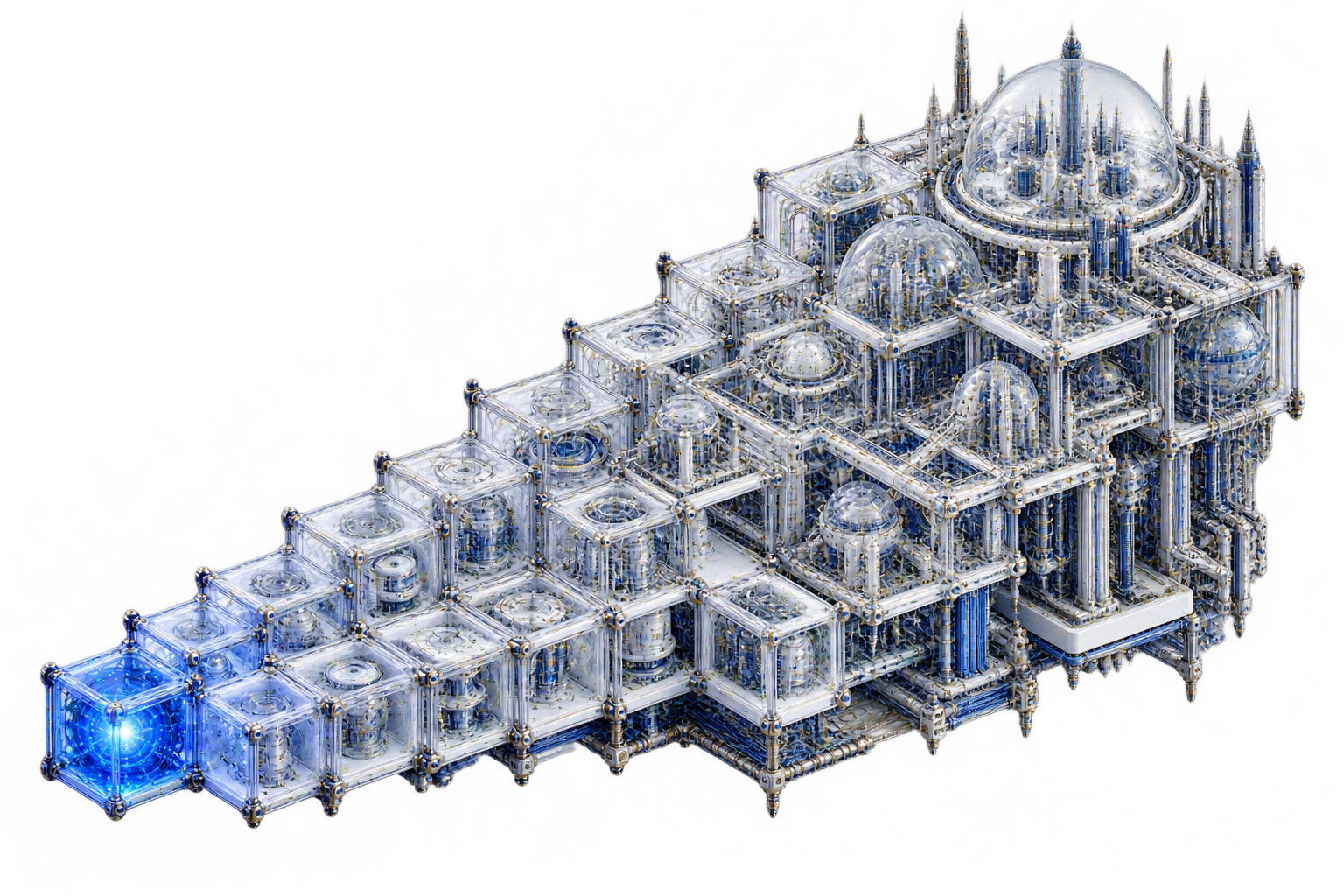
A hypothetical simulation starts with one occupied cell and one entity type. Its update rule, state space and interpretation determine later behavior. A small initial description does not specify a physical universe.
The original premise calls its first cell a Planck cube. A cube whose side equals the Planck length can be defined mathematically, but that does not establish a smallest physical volume. Planck units combine familiar constants into a suggestive scale. They do not demonstrate that spacetime is a cubic grid, that time advances in synchronized ticks, or that a universe starts with one cell.
Cell geometry and update timing are assumptions. A short program can still require substantial execution time and storage.
Complexity from a completely specified rule
Emergence must recover the details.
Real emergence is a relation between descriptions. A proposed microscopic rule must show how larger-scale behavior follows, in an appropriate regime. Merely naming the later structures quarks, photons and galaxies does not derive their properties. A serious model would need to account for observed symmetries, interactions, quantum statistics and the successful quantitative predictions of existing physics.
A preferred cubic grid also creates questions about direction and motion. Why do experiments not reveal that grid as an obvious preferred orientation or rest frame? Some discrete approaches seek ways around such problems, but the burden is in the derivation and the data. Visual complexity alone supplies neither.
Likewise, “expansion” in a picture can mean occupied cells spreading across a fixed board. Cosmological expansion concerns the evolution of spacetime geometry. Resembling an expanding triangle does not reproduce inflation, the cosmic microwave background or the growth of large-scale structure.
A toy system can show
Simple rules generating intricate patterns; dependence on initial conditions; differences between description length and runtime.
It cannot establish
That the observable universe is computed, that Planck cells exist, or that familiar particles arise from the displayed update rule.
What would turn the story into a research proposal?
A research model requires explicit mathematics, defined observables, agreement with established results and a distinctive test. Reproducing one pattern is insufficient when alternative rules generate it.
The simulation hypothesis adds another layer: even a successful discrete physical model would not by itself demonstrate an external programmer. Nick Bostrom's simulation argument is a conditional philosophical argument with assumptions about civilizations and observers, not evidence for this particular seed. The productive use of the premise is to sharpen questions about emergence, computation and explanation while leaving its imagined origin visibly unproven.
One further test is explanatory economy. A single particle name does not make a model simple if its update rule secretly encodes all known physics. Compare the full specification, not just the number of entities in the opening scene.
Sources & further reading
Follow the evidence.
- 01Bostrom: Are you living in a computer simulation?
Philosophical argument, not a primordial-particle model.
- 02CODATA recommended constants, 2022
Planck units do not establish a spacetime lattice.
- 03Lloyd: Ultimate physical limits to computation
A physical computation has resource requirements; a compact description alone does not remove them.