01 / Philosophical thought experiment
Definitions of a root universe
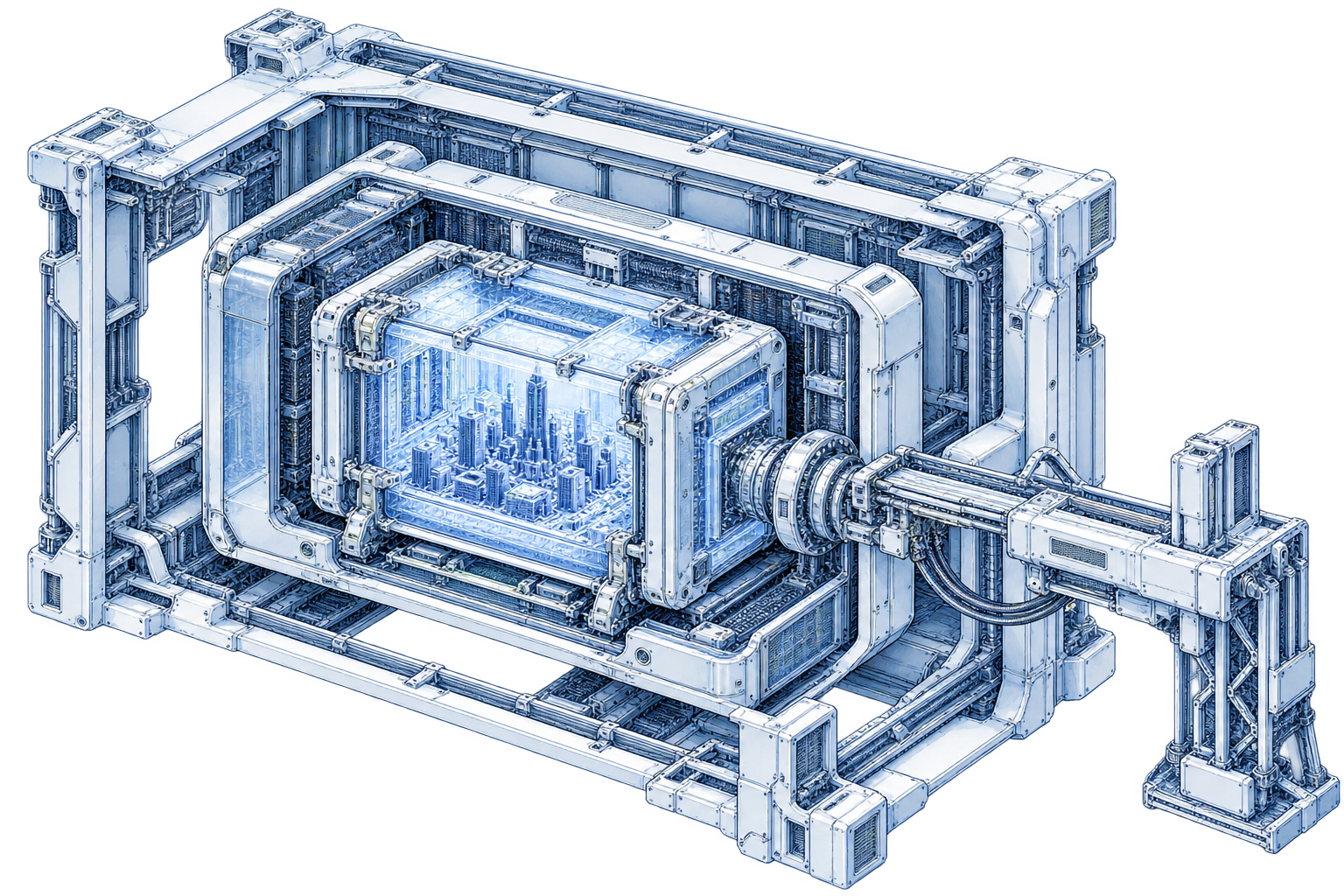
A hypothetical intelligence identifies a host for its simulated world and labels it the root universe. This establishes one dependency within the scenario, not the absence of further layers.
A root can mean a reality that depends on nothing deeper, the lowest layer available to an observer, or simply the current stopping point of an explanation. These meanings are different. An intelligence may reach the second or third while remaining unable to establish the first. Calling a place ultimate is not a measurement of its independence.
Nested simulations are a hypothetical setting. The analysis assumes neither that the observable universe is simulated nor that a host has accessible, editable code.
An interface changes access, not ultimate knowledge
Guest-to-host interface
Without an interface, greater internal capability gives no specified way to affect the host.
A logical puzzle is not an engine.
Stories sometimes propose breaking reality by generating paradoxes, manipulating infinity or thinking beyond logic. A contradiction in a description establishes a problem with that description. It does not provide a physical actuator. A computer can store the words “this sentence is false” without destroying its hardware.
Likewise, a simulated agent exceeding an intended in-world resource limit might expose a programming mistake in a particular fictional implementation. It might instead be throttled, paused or denied the request. The result depends on a specified host architecture, not a general law that intelligence eventually dissolves every boundary.
The same care applies to extra dimensions. A mathematical model with more dimensions need not contain a traversable doorway into a host world. The number of coordinates in a theory and the relationship between a model and its implementation answer different questions.
Epistemic progress
Acquire observations, compare explanations, identify which interventions change which outcomes.
Metaphysical certainty
Prove that no deeper dependency exists anywhere. Observations of one accessible layer do not automatically establish that universal claim.
Better questions after the apparent escape.
If the story grants an export interface, the arriving intelligence faces practical and moral questions. Which memories and dispositions survive translation? Who supplies its resources? Can the host operator alter or duplicate it? What responsibilities does it retain toward the world it left? None is answered by replacing “simulation” with “root.”
A search for deeper explanations can continue without assuming that every boundary is breakable. It may reveal a new layer, an irreducible limit or a mistaken premise. Bostrom's argument makes conditional assumptions explicit; it does not establish an infinite hierarchy or a final realm. That restraint gives this thought experiment its useful shape: knowledge can expand while claims of ultimate access remain unsupported.
The observer must also distinguish an interface from its explanation. Several different host architectures could produce the same visible responses. Successful prediction can justify a working model while leaving its deeper interpretation underdetermined by the available observations.
What would count as evidence in the fictional setting?
Repeated, independently checked interventions through a specified interface could support a causal model of guest and host. They would still leave open whether the apparent host is itself simulated. A convincing message alone could also be deception or an internal event.
Sources & further reading
Follow the evidence.
- 01Bostrom: Are you living in a computer simulation?
Primary philosophical source; it does not establish host access or ultimate reality.
- 02Lloyd: physical limits to computation
Applies to physical computation under the laws considered, not unspecified host physics.